

Blends for eternity
There are times when fusions make something unforgettable.
Ishi was the last cushion to be incorporated into California 1960, a detail that lived up to its name. The sample arrived one afternoon from the workshop. We all gathered around it, appreciating its texture with our fingers and caressing the details of its feathers.
-What can we call this model? - asked Martina.
All heads turned to me.
It took me a while to answer, as I had several ideas and names flying around in my head, until I finally settled on one.
-I would like to call him Ishi, after the last Native American.
And, with that, I began to remember our arrival in Palm Springs.
It took us a little over two hours to drive through Los Angeles and around Mount San Jacinto to Palm Springs. The anticipation could already be perceived in our gestures and expressions: the destination was almost upon us. The same palm trees and the same desert that we observed as we drove on would end up coinciding with those of the Kaufmann house, and with that mythical photo of Slim Aarons. We had already met Dorothea Lange, her desert and her legacy. Now we had to finish the trip.
Modernism was commonplace in Palm Springs. It looked like a giant museum, where every house, the work of some architectural artist, was perfectly preserved. Max laughed at me, as I kept asking him to stop the car so I could take pictures of the facades of the buildings.
State Highway 111 brought us to the Tramway Gas Station. The large triangular shape of its roof cast a long shadow on the ground, over which the mountain loomed in the distance.
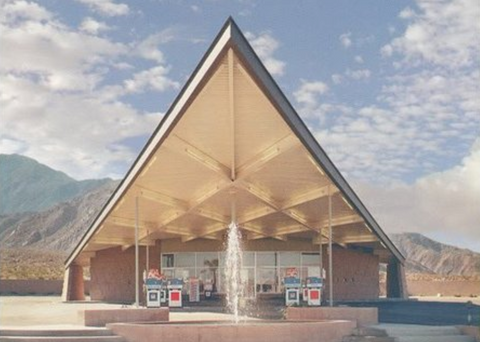
This time I didn't have to ask Max to stop the car. He slowed down as if he had read my mind. As we walked to the front door, he took my hand and I smiled at him.
The old gas station now functioned as a tourist center. Postcards and souvenirs accumulated on wooden shelves. Above one of the windows of the place stood a display case, with a metallic sign that read Palm Springs Modern. Inside were old maps and postcards of iconic houses of modernist architecture. I stopped in front of a black and white photograph, showing several women smiling at the camera.
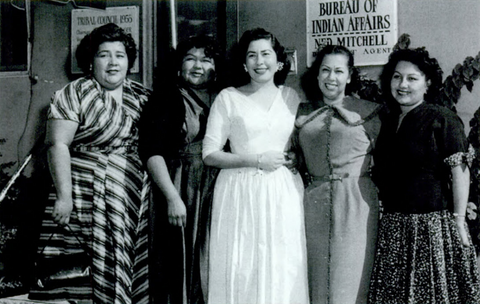
-Can I help you with anything, miss? - the clerk asked me in a southern English accent. It made me startle.
-Who are these women here? - I asked, pointing to the photograph.
He approached and put on his glasses. He frowned as he watched what was pointed at him, until at last he made a gesture of recognition.
-Many come here for the great architects and I understand them. Frey, Le Corbusier, Neutra... they all left their mark here. But they were the ones who made it possible for these men to pursue their profession. I like to call them the architects of Palm Springs' destiny.
And he told me the story of the Cahuilla de Agua Caliente.
The land and its stories were the only thing the Indians could leave to their descendants. This was a simple and sad reality. So much so, that the U.S. Congress had passed a law to protect these spaces, in which it was strictly forbidden to lease Indian lands to third parties for more than five years. It was a noble act, but only in appearance. The loose reins of capitalism had caused big businessmen and investment magnates to flee with their projects to more profitable lands, where the lease years were not so strictly regulated.
-And it was these ladies, Laverne Miguel Saubel, Elizabeth Monk, Gloria Gillette, Eileen Miguel and Vyola Ortner who decided to do something about it.
Max had approached us when he saw us talking and was listening to the story as intently as I was.
-But that law was protecting them! - he objected.
-Of course, but to the point of harm. The Cahuilla were starving. And given the extreme racism that existed at the time, there was little they could do to feed their families. It was Vyola Ortner, head of the Cahuilla Council, who took on the project. And she succeeded. In 1957, thanks to her efforts, the legislation was changed. The Indians could lease their land for usufruct for up to 99 years. And in the 1960s, a few years later, these impressive constructions began to emerge.
-How did he do it? - I asked.
-Well, she always said that "being mestizo has been good for me". She felt privileged, because she saw the fact that her father was American and her mother Cahuilla made her part of both worlds. So that made her the perfect intermediary.
***
-Ishi was from Palm Springs? - asked Sofia, curious.
-No, Ishi belonged to the Yahi, who lived further north in California. The Agua Caliente area of Palm Springs belonged to the Cahuilla.
-And why name this cushion Ishi and not a Cahuilla name? - asked Joaquín.
-Because Ishi could never say his name. Ishi is known as the last Native American. The Yahi, his people, had an old custom: no one could reveal their proper name unless another person of the same tribe introduced them personally. But since Ishi was the last Yahi, he could never tell his real name. Ishi, in their language, means "man". And that's why I want to pay tribute to him. Because blends, when they work, should always pay homage to their past.