

The importance of storytelling
I have always admired the idea of preservation. My grandparents were great collectors and avid explorers, so I think they were the ones who passed on to me that love of finding objects with stories. And every day I would strive to pass that passion on to my team. I always recommended museums, cities, places of interest and encouraged the habit of asking questions all the time. After all, my best designs had come from ideas and memories that I had arrived at by asking myself questions.
-Who came up with the idea for the museum? - asked Joaquín one afternoon as we worked on the composition of our Mustang design, which had been inspired by my visit to the reserve in California years before.
-I think it was a natural evolution of private collections," I commented. - Collectors have always existed. There just needed to be one without heirs for the collection to be open to the public.
The conversation naturally evolved to which museums we had visited. Classics such as the Louvre, the Prado, Uffizi and several others were mentioned.
-What about the photographer's originals of your project? Where are they kept? - Sofia asked. I had learned to subtly and disinterestedly request more chapters of my California story, as her enthusiasm often encouraged my desire to keep the intrigue going.
-At the Getty in Los Angeles," I replied. -Max and I visited him on our way to the Kaufmann house.
-Count! - Fernanda asked me.
-Yes," said Max as he drove along the eternal road. The landscape was ochre, cut by slight rocky elevations with pale and sparse vegetation. The terrain was looking more and more like that picture we all know from the mythical Hollywood sign. That could mean only one thing: we were getting closer and closer to our destination.
-No," I repeated, sounding like a broken record. We sounded like two little kids. I couldn't help but keep an eye on his right hand, which, when he wasn't changing gears, was gesticulating in an attempt to reinforce his arguments.
-Let's see, Manuela, if you put something, whatever it is, behind bulletproof glass and every now and then you restore it, you want to freeze time. And that is something totally unnatural, so for me museums are like tombs of the past. They even exhibit sarcophagi!
-But what you describe to me is a definition of a traditional museum. There are places where you can't just rip the history off the walls and take it somewhere else," I replied.
-What are you talking about? But they have even taken entire Egyptian temples!
-It's not like that!
-Convince me.
For a moment he took his eyes off the road and we looked at each other. He was enjoying our argument.
-Okay," I said. - When we get to the museum I'll show you.
-We were already on our way to the Getty, because I wanted to see the Lange originals, which were on display," I continued.
History had consumed the team again. Everyone had left scissors, pens and mice. They were hanging on my story.
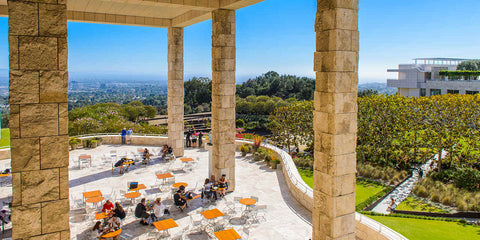
Museum, park and research center, the Getty Center stood before our eyes with its impressive modernist architecture. We left the car in the parking lot and headed to the top of the hill, where the entrance to the building was located. The legacy of a great American oilman, patron of the arts, the museum buzzed with activity. Students, researchers and tourists strolled through its gardens, admiring its facade.
-Where do you want to start?
Max looked at me and shrugged.
-You tell me.
We started with the painters. Van Gogh, Rembrandt, Sorolla, Monet... they were all there. Tourists and students crowded between each of the paintings, fighting to take a picture of the painting.
-I never understood why they take a picture of it. I'm sure the gift store sells better duplicates.
We passed by several views of the garden and agreed that after meeting Dorothea Lange we would stretch our legs there.
We entered the photography section, looking around, searching for our assignment. Portraits and landscapes decorated the walls, showing realities as different as they were changing. We stopped every now and then, thinking we had found our target, but soon resumed our march.
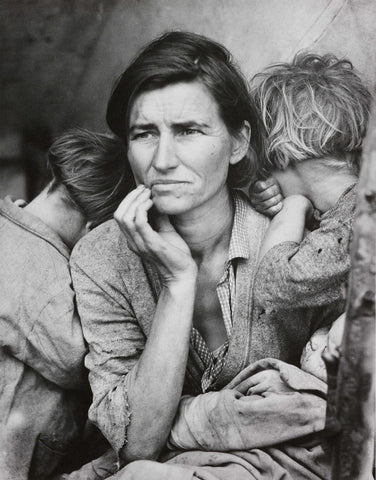
She was waiting for us discreetly, at the end of one of the corridors. The Migrant Mother was gazing into infinity, worrying about the future of her children, who were resting on each of her shoulders. We slowly approached to observe her.
-Can't you see it? It's frozen in time," Max mutters.
-It is not like that. This photo is a symbol of what was a very hard time for this country. It is a constant reminder of the road we have traveled, which helps us to be aware of where we should not go back to. You say that in museums there are only dead things, but this is not so: memory is something that is constantly alive and that nourishes us every day. If it were not so, how would we make sure that history does not repeat itself?
Max remained motionless as he listened to me, mesmerized by my words.
-That's why storytelling is so important," I said.
We walked through the rest of the museum in silence. We went out into the gardens. The afternoon sun was beating down on the maze-like trees and bushes. The silence between us was not uncomfortable, but it did make me watch Max's every move. I wanted to know what he was thinking. After a while, unable to hold back, I asked him:
-So, how's it going? Did I convince you?
Max paused, lifting his gaze from the floor.
-Yes.
I smiled.
-Well, I'm getting tired of having to prove so many things to you," I said, laughing.
He came up to me and without another word, kissed me.