

The secret of the spy-monk
I am a firme believer that a good setting can make all the difference, facilitating conversation and impressing diners. Little by little, the elements must come together until a special harmony is achieved. And there is no more key element on a table than the tableware.
The tableware is the setting in which the meal takes place. It is the first thing that is seen before serving and the last thing that remains with the after-dinner meal. That is why at Lo de Manuela we pay special attention to it and focus on a unique and eclectic design, with the quality that only Limoges porcelain can offer.
In the early 18th century a French monk-spy living in China studied in depth the secrets of his exquisite porcelain, the alchemy of water, fire and earth, and passed on the information in detailed letters to his native France. Indispensable to the equation seemed to be the use of white clay, something the French did not have. When in 1767 a deposit of kaolin, the longed-for white clay, was discovered in Saint Yrieix la Perche, near Limoges, the rich history of French porcelain par excellence began.
From there, the specialty of this town has become that of creating these pieces, which have been part of the finest dinners all over Europe. Today, industrialization has meant that few factories in this city continue to produce them.
Limoges porcelain has been present in all our collections. There are several motifs and lines to choose from. This does not mean that they are exclusive pieces, on the contrary: the harmony of the whole grows with each design, and invites to add and mix with each other.
On the one hand we have our African animals: the lion, the tiger, the leopard, the zebra and the crane, which give a wild and elegant touch to any table.
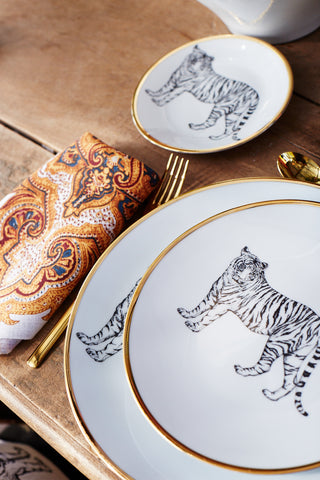
To this collection we add the parrot, inspired by our adventure in Petrópolis, where we try to capture the song of the macaws, the soundtrack of the Atlantic jungle of that city.
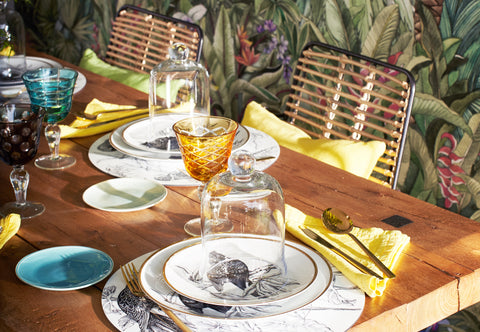
This year, our animals expanded and reclaimed a territory that has always been theirs: the Shamba, in the savannah, where baobab and adansonia break the monotony of the pastures.
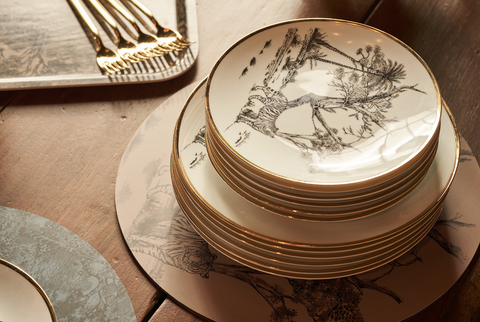
Finally, we have two wild cards: our ikat and our palms design. Either individually or together, or combined with any of the animals, they give a breath of fresh air to the table and make it more diverse and interesting.
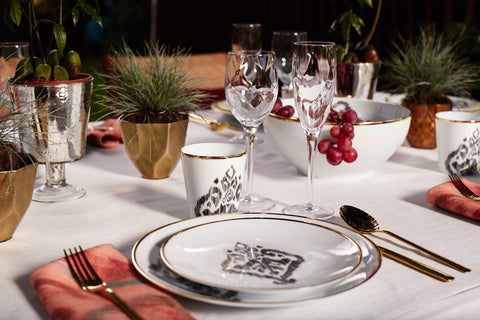
Our pieces, manufactured in this iconic city, are created from special molds for porcelain. Once the piece is formed, two techniques are used to finish the product.
First, silkscreen printing is used, which is the way in which the drawing is transferred to the porcelain. This process involves the use of a mold, which is manually applied to each object.
The final touch of grace is given by the golden filo. It is painted by hand with a brush. One by one, plate by plate, piece by piece. This makes each of the elements of our tableware part of an exclusive club: one where everyone has their own unique and non-transferable handmade touch, with a quality delivered by a factory and a city that has been dazzling us for centuries.
Limoges porcelain tableware is something full of history, which shines in the past without ceasing to pulsate in the present. The gesture of recovering the validity of this porcelain tableware is another example of our filosophy of wanting to modernize while paying tribute to the customs of our grandparents. It is the ideal component for any table.